The ConfUSIus Dataset Collection
ConfUSIus provides access to public fUSI datasets and brain templates from several studies. The datasets user guide describes the available data, fetchers, and source publications; the collection repository documents preparation recipes, provenance, and per-source licenses.
This example introduces the collection's organization and access conventions. The other gallery examples demonstrate how to use these data for registration, decomposition, connectivity, and statistical analysis.
Browse the collection
The public S3 bucket contains two prefixes, datasets/ and templates/, with
immutable releases under <identifier>/<version>/. The last_versions.conf
catalog lists the latest published versions; each release's manifest.json
records its file paths, sizes, and SHA-256 checksums.
Fetchers resolve the latest published release on the first download, then reuse
the cached version. Pass refresh=True to check for a newer release without
overwriting an earlier one. Set data_dir for a particular fetch, or the
CONFUSIUS_DATA environment variable to choose the download-cache directory for
all fetchers (for example, export CONFUSIUS_DATA=/path/to/cache). data_dir
takes priority; otherwise the platform cache directory is used by default.
list_datasets prints the available fetchers,
full dataset/template sizes, and whether their metadata is cached locally,
without downloading data.
from pathlib import Path

import matplotlib as mpl
import xarray as xr

import confusius as cf

xr.set_options(display_expand_data=False)
bg_color = mpl.colors.to_hex(mpl.rcParams["figure.facecolor"])
cf.datasets.list_datasets()
                   Available Datasets
┏━━━━━━━━━━━━━━━━━━━━━━━━━━━━━━━━━━┳━━━━━━━━━━┳━━━━━━━━━┓
┃ Fetch function                   ┃     Size ┃ On disk ┃
┡━━━━━━━━━━━━━━━━━━━━━━━━━━━━━━━━━━╇━━━━━━━━━━╇━━━━━━━━━┩
│ fetch_nunez_elizalde_2022        │ 6.983 GB │    ✓    │
│ fetch_pereira_2025               │ 29.96 GB │    ✗    │
│ fetch_cybis_pereira_2026         │ 12.88 GB │    ✓    │
│ fetch_pepe_mariani_2026          │ 37.56 GB │    ✓    │
│ fetch_landemard_2026             │ 42.04 GB │    ✗    │
│ fetch_khallaf_2026               │ 24.02 GB │    ✓    │
│ fetch_template_huang_2025        │ 16.34 MB │    ✗    │
│ fetch_template_pepe_mariani_2026 │ 5.508 MB │    ✓    │
└──────────────────────────────────┴──────────┴─────────┘
Data formats
Datasets follow fUSI-BIDS, the functional ultrasound extension of
BIDS; see the
current specification draft.
Images are stored as NIfTI files with acquisition,
processing, and timing metadata in JSON sidecars. confusius.load
loads both automatically, merging matching sidecars according to the BIDS
inheritance principle: more specific metadata overrides less specific metadata.
Templates are reference NIfTI volumes for spatial alignment; their fetchers return VoxelData arrays directly. The gallery shows how to use collection datasets and templates in analysis workflows.
Each dataset and template retains its own license. Fetchers print source citations
by default (print_citation=False disables this); citations and per-source licenses
are also listed on the citing page.
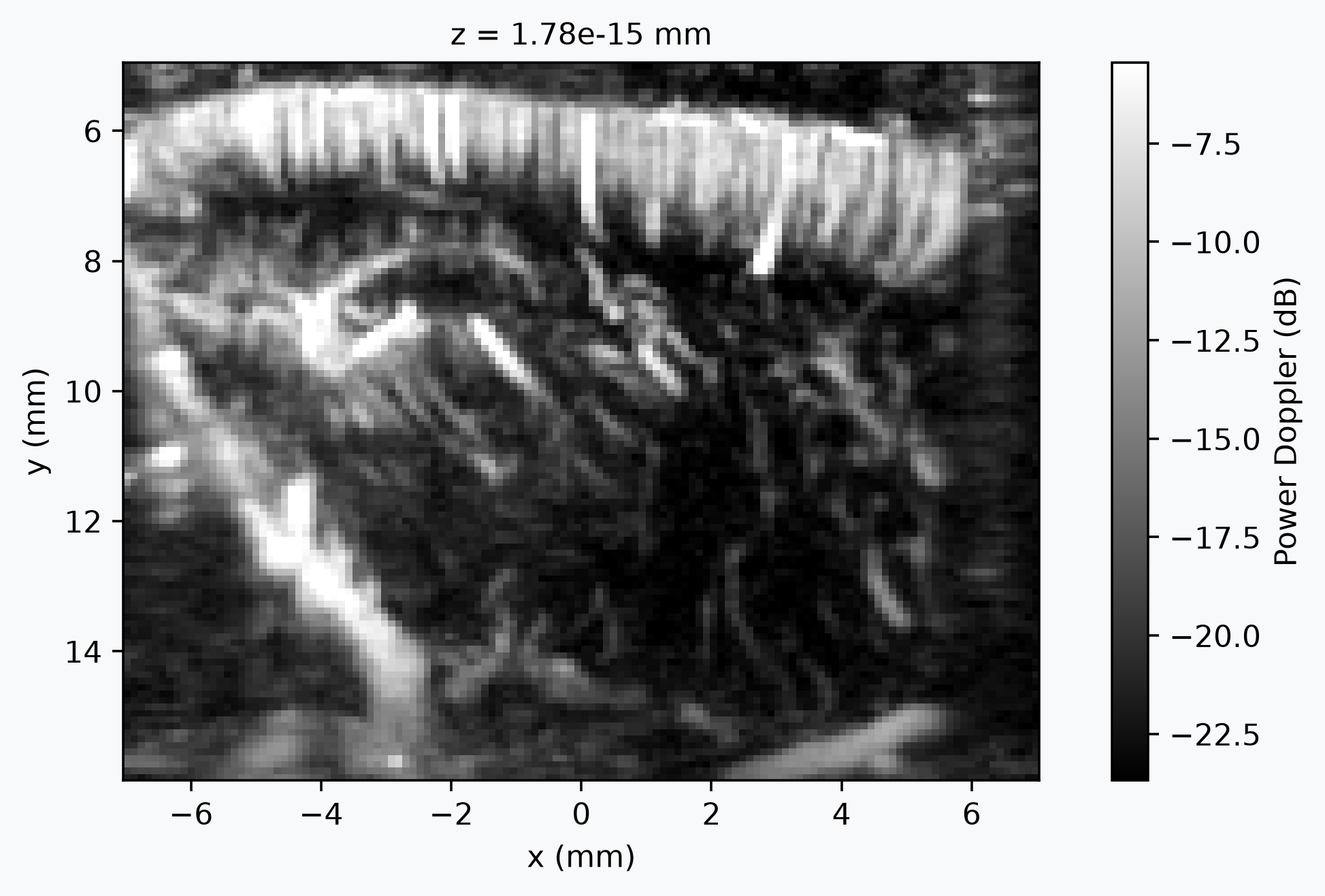
A small structural preview
As a quick view of the collection, fetch one structural ultrasound image from Cybis Pereira et al. (2026). Dataset fetchers accept study-specific filters such as subject, session, acquisition, and datatype. Matching JSON sidecars and supporting BIDS metadata are included, and downloaded files are verified against the release manifest.
For a fuller introduction to downloading, loading, and manipulating recordings, see ConfUSIus and Xarray 101.
bids_root = Path(
    cf.datasets.fetch_cybis_pereira_2026(
        datasets="rawdata",
        subjects="rat75",
        sessions="20220523",
        acqs="slice32",
        datatypes="susi",
    )
)
image_path = (
    bids_root
    / "sub-rat75"
    / "ses-20220523"
    / "susi"
    / "sub-rat75_ses-20220523_acq-slice32_rec-minframe2d_pwd.nii.gz"
)
assert image_path.with_suffix("").with_suffix(".json").is_file()
image = cf.load(image_path).compute()
assert {"k", "j", "i"}.issubset(image.dims)
print("Release:", bids_root.name, "\nVoxel dimensions:", dict(image.sizes))
If you use this dataset in your work, please cite the following source:

Cybis Pereira, F., Castedo, S. H., Meur-Diebolt, S. L., Ialy-Radio, N., Bhattacharya, S., Ferrier, J., Osmanski, B.
F., Cocco, S., Monasson, R., Pezet, S., & Tanter, M. (2026). A vascular code for speed in the spatial navigation
system. Cell Reports, 45(1). https://doi.org/10.1016/j.celrep.2025.116791
This is a static anatomical reference, with vessels that can serve as alignment
landmarks. Display it in the source's metric qform space, as in
two-session registration.
image_qform = image.fusi.affine.apply(image.attrs["affines"]["world_to_qform"])
plotter = image_qform.fusi.scale.db().fusi.plot.volume(
    cmap="gray",
    cbar_label="Power Doppler (dB)",
    bg_color=bg_color,
)
Explore the data further
The worked analysis examples show how to answer scientific questions with these recordings, including the preprocessing, models, and visualizations:
- Lagged GLM: how does vascular activity relate to locomotion speed? Reproduce the Cybis Pereira analysis with a continuous behavioral regressor at different temporal lags.
- PCA: which spatial patterns explain the dominant variance in a recording? Extract component maps and time courses.
- Task GLM: which regions respond to olfactory stimulation in the Khallaf recordings? Fit and visualize a stimulus contrast.
- Regional connectivity: how do atlas-defined regional signals covary in the Nunez-Elizalde recordings?
Beyond these examples, the ConfUSIus dataset collection can support further analyses and cross-study meta-analyses, taking each study's acquisition and processing differences into account. See the citing page for source references and licenses.
Total running time: 5.4 s